Showing posts with label tech. Show all posts

Saturday, January 28, 2012

TorqueArm Tech


Quick Facts about Torque Arm Kits

  • Increases rear traction (forward bite)
  • Decreases stopping distance significantly
  • Engineered to maximize ground clearance
  • Can be used without other rear suspension modifications
  • Presets pinion angle
  • Longer U-joint life
  • The most driver friendly way to hook up power.
When used with a Panhard Bar or Watts Link the TorqueArm will substantially improve overall controllability of the vehicle regardless of power output because it:
  • Allows for the removal of the rear upper control arms and quad-shocks on cars so equipped.
  • Decreases snap-oversteer
  • Corrects rear roll center location
  • Decreases rear bind
  • Inspires driver confidence


The TorqueArm when coupled with a Panhard bar or Watts link is the best in terms consistency of control and improved braking due to is constant and consistent tire loading regardless of ride height changes as the car encounters surface irregularities, cresting hills, etc. Compared to 3 link, 4 link, 5 link or IRS designs, the improvement in car control under power offsets any arguable merits of the other systems in a high powered rear drive vehicle that is without aid of high down-force aerodynamic devices. For this reason the same basic geometry is used on most Sprint Cars, Supermodifieds, Late Model Stock Cars, and other professional race cars around the world where rules allow.  
TorqueArm geometry would be used in more forms of road racing were it not for rules restrictions in various organizations such as TransAm, and NASCAR, or where aerodynamic packaging is the priority of design as in Indy cars and Formula 1.   
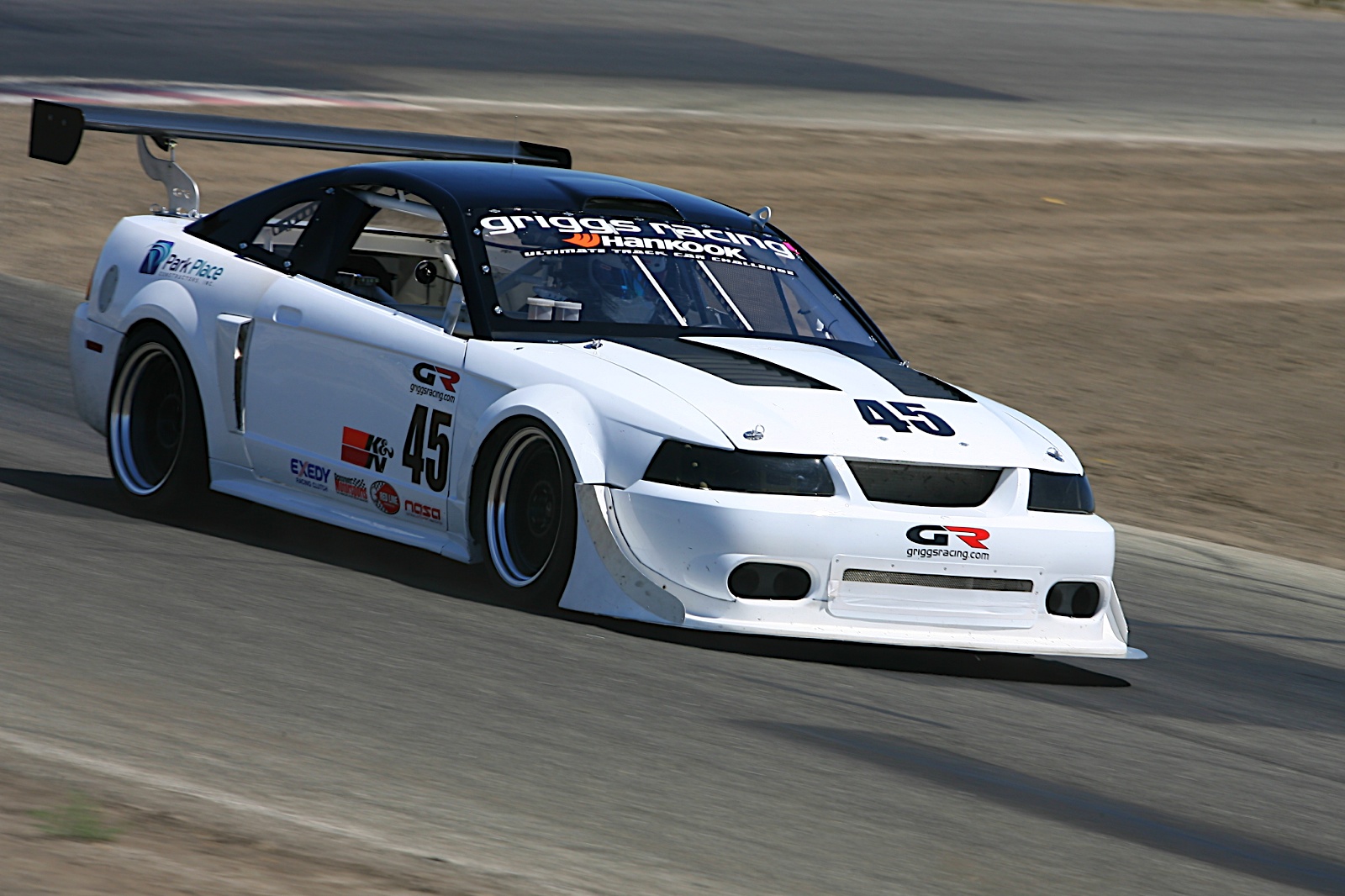
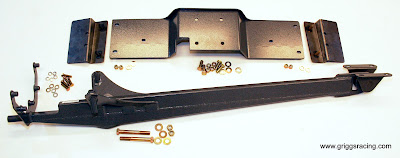
Griggs Racing was the innovator of TorqueArm design application to the Mustang in 1979, and has produced many versions and improvements since its inception.  Currently there is one basic off the shelf versions of Griggs Racing TorqueArms; Severe Duty. The severe Duty TorqueArm is intended for most applications; from street use on cars with stock engines and transmissions to cars with over 500 RWHP and sticky tires that are drag raced, brutally road raced, autocrossed, or similarly abused. The structure of the severe duty TorqueArm consists of the appropriate appendages for the model and axle used, attached securely to the severe Duty arm.
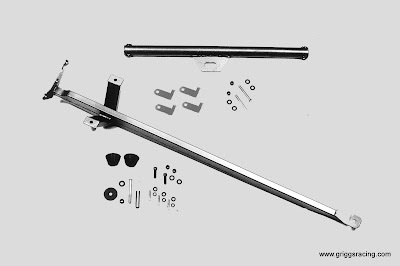

These are not hard and fast rules and when in doubt you should contact us for specific recommendations for your application.  The Severe Duty TorqueArm is the most popular and Bruce Griggs races his AIX cars on the severe Duty TorqueArm and his cars exceed the power level described above and still win while being completely durable race after race. If absolute durability regardless of abuse is the priority, you should choose the Severe Duty unit which is the most popular or contact engineering@griggsracing.com for a specific recommendation for your application.

Friday, October 14, 2011

What is a watts link and why do champions use them?

S197 Quiet Watts Linkage


Watt's linkage (also known as "parallel linkage") is a type of mechanical linkage invented by James Watt (19 January 1736 – 25 August 1819) in which the central moving point of the linkage is constrained to travel to a straight line within a certain travel length. Its applications in automobile suspensions are that of allowing the axle of a vehicle to travel vertically while preventing sideways motion. This type of locating device, however, does so much more than that for a race or track prepared vehicle. 

SN 97 Watts Linkage installed


Watt's linkage is used in the rear axle of some car suspensions as an improvement over the Panhard bar or rod, which was designed in the early twentieth century by a French car company of the same name. Both methods intend to prevent relative sideways motion between the axle and body of the car. Watt’s linkage approximates axle movement in a vertical straight line motion more closely, and does so while locating at the center of the axle rather than toward one side of the vehicle, as more commonly used when fitting a long Panhard rod. By locating the center of the axle the roll center of the vehicle can be clearly defined and thus be predictable and, in the case with Griggs Racing Watts links, completely tuneable. In fact we have found that our tuneable watts linkage lends itself to consistently Quicker lap times than a Panhard Bar. The reason for this is because, unlike a Panhard Bar, both right and left cornering characteristics are identical. This is due to the fixed roll center relative to ground of the GR40 Watts link, which is not so with Watts links from other companies.  

Not only are the linkages fully adjustable laterally for accurate real axle alignment, but also the Pivot which locates the roll center is vertically adjustable allowing quick easy and tuning of chassis balance with accurate and predictable results simply by unbolting it and moving it up for reducing understeer, and down for reducing oversteer. This Increases controllability and driver confidence under power and in cornering because the driver can predict easily what the vehicle will do. By having this adjustable rear roll center drivers have found maximum corner exit traction achievable while optimizing corner balance for faster lat times, and therefore optimizing their driving experience.  


SN 95 Watts Linkage/ TorqueArm  assembly  


 When used with a TorqueArm lateral tire loads are made independent of changes in engine & brake torque loads, vastly improving handling and power, applied performance, and braking making this rear suspension geometry THE best choice for competition vehicles, drag, autocross, road racing, and serious open tracking. However if a TorqueArm cannot be used due to race class rules or various other reasons the Griggs racing watts link can be installed independently of  our TorqueArm on any 9 " rear axle in any vehicle.  On Cars equipped with 8.8 rear ends, the addition of a TorqueArm Delete Bracket is required.


Watts Linkage for Ford 8.8" with TorqueArm Delete 


You can also trust that the Griggs Racing Watts link kit is going to be light adding minimal sprung and unsprung weight when compared to all other lateral linkages on the market. Not just light but also very strong; No bends in the main brackets affords zero flex and zero chance for failure of a well set up system. large tire guys need not fear either since the Griggs racing Watts linkage kit positively locates the rear axle laterally  use of maximum tire sizes is allowed with the least chance of rub.  

A further feature is the progressive failure design.  This feature has been proven real world testing. Lateral impact, such as impacting a curbing, can result in serious damage in competitor's systems, but in the GR40 Watts link each part is designed to fail in progression. If the standard Watts link with Aluminum Arms is installed, in an impact, the arms bend first, then the bell crank fails, then the main plate.  This usually saves the Aluminum rear end cover and the chassis bracket, so a quick repair can often be made so the car can continue to race.  This is not possible with copy cat designs that delete the Main plate. 


Therefore the very best choice in a lateral axle locator available regardless of ride height movement is The GR40 Watts Link.


Want one for your ride? Contact us at Sales@Griggsracing.com to get yours.

Wednesday, September 28, 2011

The GR40 Suspension System


Why the stock Mustang suspension doesn't work and how Griggs Racing fixes it

In the beginning Fox bodied and SN-95 Mustangs feel so good. There's the easy V-8 power, the light steering and quick handling. Compared to other street cars the Mustang is ready and nimble, a joy to drive.
But for the ever-learning enthusiast there comes a day when that magic Mustang sunshine dims. Often it's because another, modified Mustang showed you its taillights, or perhaps you took your Mustang to the drag strip or slalom. You begin to notice things, like how the rear end seems so inconsistent. At the strip the car never seems to launch the same, and when you get what feels like that rare perfect launch, the tires blow off just as soon as the car gets rolling. Your front tires grind off their outer front edges long before the rest of the tread shows any real wear. Start whipping around freeway ramps faster and your Mustang begins to feel unsure; you find yourself waiting for the rear end to snap out unexpectedly. Ultimately, your Mustang feels more over-powered and less capable than simply fast.


All products are abused on the track prior to making it to the street.


Those first moments of insecurity about your Mustang's white-knuckled handling at the limit, or its fickle appetite for traction at the strip are not your imagination hitting the rev limiter. Those are the first realizations the Mustang chassis is far from delivering the confident handling its high-output powertrain deserves.

At Griggs Racing we've dissected the Mustang chassis and suspension to identify its shortcomings and engineer cures. Our fix for the Fox and SN95 chassis Mustang is no quick medicine; it's a fundamental change in the suspension geometry that yields a fundamental handling improvement. Our suspension is also adaptable to a huge range of Mustang performance. From the street, to the strip, road course or slalom circuit, our re-engineered GR-40 suspension system provides the stable, consistent, responsive platform you need. It's only shortcoming is it has to be experienced to be believed.


So what are the issues working against you in the Fox and SN95 chassis Mustang? For starters, the unibody structure is lightly built, with insufficient rigidity. High torque and cornering loads deform the structure, causing the suspension to lose precision, doubly so with convertibles. Welding in reinforcing structure is the cure.


Knowing where to reinforce the structure is important, as indiscriminately adding braces wastes money and adds weight without gaining meaningful increases in rigidity. By twisting a Mustang unibody on a frame table, we learned the main problem is in the middle of the car. Ford counts heavily on the rocker panels as the primary structure between the firewall and rear wheelhouses, especially with the '79-'04 cars. This lets the front and rear axle forces to twist the car far too easily.


Naturally, a full roll cage will cure this, but that solution is cumbersome and expensive on street cars. More practically, a dual-plane brace to provide triangulation of the floor pan is required; we do this with our Full Frame Kit.

The mid-car twist also explains why we don't offer g-load and strut tower braces. By strengthening one end of the car they actually increase the mid-car twist.

An even larger concern is found in the rear suspension. Ford uses a 4-link design, but with the upper two control arms angled heavily outward. This means the lower and upper rear control arms are not parallel, so as the suspension moves the upper arms are twisted in their bushings. During performance driving this quickly leads to a near total binding of the rear suspension, called roll bind. With the axle bound, it acts like a giant anti-sway bar, causing the rear roll stiffness to skyrocket and the overloaded rear tires to loose traction and spin. This is why the rear end snaps into uncontrollable fishtailing when cornering, and it is also why the rear tires break loose at the drag strip once the body starts rising from the initial power hit.


2005+ Griggs Racing TorqueArm and Panhard Bar


Ford addresses the roll bind by fitting the upper arms with very soft bushings, a sloppy fix, to say the least. Our cure is to fit a torque arm and either a Panhard bar or Watts link to provide the necessary axle location, then remove the stock upper arms. Roll bind is then impossible, and the tires freely follow the pavement.

You may have noticed we use two locating devices, the Torque-Arm, and either a Panhard Bar or Watts link, to do the job Ford uses just the upper control arms for. This is to separate control of the fore-and-aft engine and braking loads from the lateral suspension loads. More precise suspension control is then possible.


GR40 Watts Link
Additionally, the rear roll center is now defined by the Panhard bar or Watts link instead of the upper control arm angle as Ford had it. Stock the Mustang's rear roll center is far too high, which overloads the outside rear tire and causes oversteer. By lowering the rear roll center with the Panhard bar or Watts link we get the rear tires to carry more of the load so the rear end will stick longer.
More compromised geometry is found in the front suspension, a point made abundantly clear when driving a car with the rear suspension fixed and the front suspension stock. Ford built the Mustang with generous steering axis (king pin) inclination, which requires equal amounts of caster to keep the tires flat to the ground when turned. Unfortunately, Ford gave the Mustang only minimal caster, a condition we reverse with caster plates and redesigned K-member.


GR40 SLA System
Also at the front, Ford's tall ride height comes into play. Lowering the entire car benefits the center of gravity, but causes the front suspension geometry to lower the front roll center well below ground level. Combined with the tall rear roll center, this results in a roll couple (the relationship between the front and rear roll stiffness, of which roll centers play a part), to heavily load the front tires. Imagine trying to drive your Mustang around a corner with the front end squashed below ground level and the rear end raised a yard or so in the air; obviously the car would be trying to turn using just its front tires. That's about what the stock suspension tries to do. Lowering the rear roll center with the Panhard bar or Watts link helps this condition, of course, but we also raise the front roll center, accomplished by relocating the points where the front suspension attaches to the chassis. Moving the suspension pickup points is done by redesigning the K-member, which is the crossmember the front suspension attaches to. Redesigning the K-member also allows us to add more anti-dive to the front suspension help correct the lack of caster.

Ackermann is also a concern on stock Mustangs. Ackermann is the steering geometry that steers the inside front tire more than the outside tire, a necessary condition as the inside tire follows a smaller diameter turn radius. With the Mustang, Ford actually ended up providing reverse Ackermann, meaning the front tires toe-in slightly when turned. We also cure this with our K-member.
So, did Ford really goof terribly on the Mustang? Well, not by accident. By selling a relatively high-powered, inexpensive car into the youth market, Ford wanted a car that signed off in the handling department so soon that only the fool-hardy would get in high-speed trouble with it. In short, Ford designed the Mustang for inexpert drivers.

Unfortunately, dumbing-down the chassis is a common manufacturing tactic in the affordable performance car market. That is why it is so difficult to describe the incredible improvement a complete chassis re-engineering provides; few enthusiasts have experienced the huge thrill of piloting a powerful V-8 machine that starts, sticks and stops as well as it's engine goes. Once you've wheeled a GR40 car, however, you'll be one of the few.

Monday, September 26, 2011

The GR40 Mustang Experience


Although the S197 Mustangs are a huge improvement over their predecessors, their limitations remain, designed to keep average drivers cocooned. Understeer is, if not grinding, excessive to the enthusiast. Precision is leagues better but hardly ideal, the rear axle hops when driven hard and the whole thing is too heavy. Furthermore, as power is significantly increased with superchargers and such, the compromises in the stock suspension are made more apparent. So, while the S197 Mustangs do well making the meek feel sporty, they still need significant help before they are sporting.
Griggs Racing GR40
As we investigated the new Mustang, we were thrilled to find a highly rigid—if heavy—chassis, and disappointed to encounter weaknesses in the spindle, ball joint and K-member. They dashed any hope of lightly modifying the car up to Griggs standards, resulting in a new set of highly developed A-arm front suspension parts that are lighter, stronger, more durable and far more precise. In the rear Ford’s 3-link suspension needs corrective measures when lowered, and is best replaced by our proven torque arm system for the ultimate in axle control and traction. The bright spot is the unibody; thanks to Ford’s stiff chassis there is no need for supplemental reinforcements such as subframe connectors, saving money, time and weight.
Transformed with a full Griggs suspension, the result is simply stunning. The GR40 suspended S197 Mustang graduates into a real sports car; a delightful, precise companion in the curves. Building on Ford’s new found chassis rigidity, the Griggs SLA front and torque arm rear GR40 suspension puts feel in the steering and delivers front end grip that has to driven to be believed. The car points into the corner with enthusiasm and carves right down to the apex with a light, precise, linear feel to the steering. This authority is even more appreciated in mid-corner, the place where the stock steering goes vague and responds slowly and unevenly. Here the GR40 front suspension, its tires flatly planted to the asphalt, answers with immediate, precise corrections. It’s a revelation to anyone experiencing the joy of piloting a precise, spirited chassis for the first time, or to the old hand who didn’t expect such excellence from a heavy powerhouse such as the Mustang.

Squeeze on the power and the GR40 answers with torque-arm traction, the bite that handles both huge torque and yet remains precise to the throttle. And bumps? They soak into the rear suspension and stay there while the tires remain on the ground. This is one confidence inspiring suspension; you can stand on the gas and the rear tires will claw the car forward while the supple front end takes care of directional duties without fuss.

Griggs Racing S197
Also unexpected is the incredibly civil ride from the GR40 suspension. It feels as plush as the stock suspension, and in the bumps when trying hard, even more so. The combination of stiff chassis and accurate, correct GR40 suspension geometry means we can let the wheels move up and down, which in turn delivers a ride that’ll please the fussiest daily commuter.
If the GR40 system has a fault on the S197 it’s that it works so well you’ll want more from the tires. The car tracks so honestly right up to the limit, and has such gentle manners as the tires sign off that you’ll be ready for more grip. It’s that good.
Griggs Racing 4 on 4 Brakes
I must also mention the 4on4 brakes. Besides reducing unsprung weight, these brakes offer a new level of precision in the brake pedal. This is especially true in the brake release, an area where stock brakes are absolute dullards. The 4on4 brakes let go of the discs with the same sensitivity they apply them; on open track day that means slowly coming off the brake in perfect confidence while the tail end –so expertly controlled by the GR40 gear—rotates magnificently outward as much or as little as you wish. The transition from threshold braking to the throttle while holding the car at the limit has never been so rewarding.

So yes, the S197 Mustang is a huge step forward by Ford, and the GR40 suspension delivers the full promise of this greatest of all Mustangs

Sunday, September 25, 2011

What Are You Going To Do With Your Car


With so many Mustang parts on the market, choosing the right ones can be a daunting task. Our own huge parts list is no exception, and to jump-start your GR40 parts decision process we need to ask you what your Mustang plan is.
Begin by answering the following questions.
  1. What is the ultimate goal of my car?
  2. Will my car remain street legal?
  3. Is my car an occasional-use toy or must I drive it everyday?
  4. How important is ride quality?
  5. Is my priority straight line or cornering performance?
  6. How much power will I end up with in the long run?
  7. Do I realize my demands on my Mustang's chassis will increase as I add power and traction?


We know it can be surprisingly difficult to answer these questions, but you've got to start thinking about what your goal for your car is.
Buying parts piece meal usually results in a hodgepodge of components that, acting together, don't address the inherent problems of the chassis for your particular application. We have developed systems and sub-systems to assist you in developing the chassis you not only want, but need, in a step by step method that keeps the car balanced and usable between steps, and precludes buying things twice.
The only way to achieve the Mustang of your dreams is through the proper selection of parts that compose a system that properly affects the car's handling characteristics for the specific use of the car. If you have not made a definite determination as to the usage of the car you will have a difficult time building it correctly the first time. We have broken this catalog down into sections that address the majority of applications. If you read the descriptions of the parts and systems thoroughly you should be able to make a determination that will save you a lot of time, money and grief. Starting with late model (1979-current Mustangs and 1983 to 1988 T Birds), which are all variations of the GR-40 Suspension Package, they are:
• Strictly Street or Daily Driver. Where safety in handling and wet weather is coupled with good ride as the primary parameter, along with a lowered look. The bonus in this GR40 combination is a Mustang capable of taking freeway onramps as well as some of the finest European sport sedans. If you want a strictly street toy–or what some call a “Sunday Driver”– a car capable of delivering high doses of horsepower to the ground, and performing incredibly on an offramp, you need to build to the Street/Autocross/Open track specification listed below. If you want a stoplight racer, build a Street/Strip car.
• Street/Strip, where the car is (streetable) usually driven daily but straight line launches and an occasional trip to the drag strip is called for.
• Street/Autocross/Opentrack. If you want to drive your Mustang to work still your primary interest is high performance handling, both in a parking lot around cones and on open road racecourses, this is for you. This car could also be called a “Canyon Runner.” Some call them “Porsche Hunters.” Generally the cornering speed capability is nearly double that of a stock Mustang chassis and cornering surpasses everything you come across.
• Drag Race only, for serious single purpose drag race cars. Weight savings is unsurpassed, and safety is immensely increased over any other system due to the improvement in high-speed stability and response.
• Road Race Only. If you are a serious wheel to wheel road racer, we have a full line of products to prepare your Mustang for a national championship.
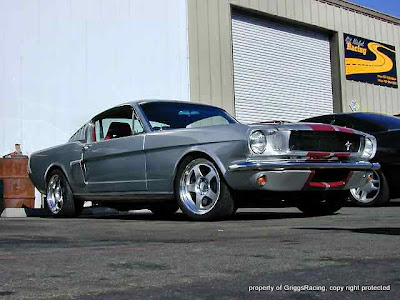
• GR-350 Vintage Mustang. This section addresses 1964 through 1971 Mustangs prepared for serious open track use. If you own a high powered vintage Mustang and want to eliminate the white knuckle ride and add incredible world-class handling performance to your prize, this system is for you.

Thursday, September 22, 2011

Some helpful definitions


The world of automobiles can be a strange and frightening place before you even think of donning fire proof coveralls, helmet, and a Hans device. So to make this a little bit easier on all of us here are some helpful definitions which should come in handy when reading our tech articles. We wont blame you for correcting your friend when he mistakes understeer with roll steer. Go ahead be smug. You are welcome.

  • Roll Center - Both front and rear suspensions have a Roll Center. This is an imaginary point around which the body of the car will rotate in a turn. The attachment points of the suspension components determine the Roll Center.
  • Roll Axis - A line between the front & rear Roll Centers.
  • CG (Center of Gravity) - The center point of the vehicle's mass.
  • Understeer - When the front tires lose traction first.
  • Oversteer - When the rear tires lose traction first.
  • Neutral Steer - The ideal balance when the front & rear tires gradually give up traction at an equal rate.
  • Spring Rate - Expressed in pounds per inch, it is the force necessary to compress the spring, i.e. a 200 lb spring requires 200 lbs to compress it 1 inch, 400 lbs to compress it 2 inches, etc.
  • Motion Ratio - Specifically we usually refer to the relationship between the motion of the wheel and the motion of the spring; i.e. If the spring is half the distance from the control arm pivot as the wheel is, the motion ratio relative to the wheel is .5 to 1.
  • Wheel Rate - The combined effect of spring rate, motion ratio, friction and/or binding of other suspension components measured at the wheel
  • Roll Bind - Any binding of suspension components that occurs as the body of the car leans over in a turn
  • Roll Steer - Generally refers to a steering effect on the rear axle as the car leans over in a corner. Caused by the rear control arms pivoting around their forward mounting point, drawing the axle forward as the arm moves up or down.
  • Bumpsteer - Toe change as the suspension moves up & down
  • Ackerman - Or in other words Toe out in turns. When turning the inside tire must turn more than the outer tire because it is turning on a smaller radius
  • Camber - Expressed in degrees, it is how much the tire leans in or out
  • Caster - The forward inclination of the spindle or strut - like the forks on a bicycle
  • Toe - The difference in the distance between the leading and trailing edge

Safety Is Our Primary Concern!


click to view full-size photo
Below are photos of the results from an 100mph plus head-on encounter into a concrete barrier at Laguna Seca. Cause of the incident was deemed by SCCA officials as a "racing accident" contributed to by great speed differential between cars in the group. The contact car was a Miata. Other than pieces of wheels, remnants of right front fender and small shards of hood, this is exactly the way the car looked when it was brought off the track. We believe this is testimony to the integrity and efforts toward safety we at Griggs Racing put into every GR40 Mustang. However, it is also a lesson.
One of the reasons we race Mustangs is the incredible crash integrity Ford built into the tub of the car. However, it was never designed to take a hit at this kind of speed. So over the years we have carefully sought to improve the crash integrity along with the performance, building our parts strong enough to perform, yet light and soft enough to deform in a crash to reduce the potential for cockpit penetration or crush.
If you carefully look at the pictures, the cage and frame kit are not the least bit distorted, the engine and drive train was contained, and drivers compartment penetration was near zero, as was distortion to cockpit structure. The K member had been on this car for nearly 7 years, 5 of which as a daily driver and open track car before conversion to a race car. Although lightweight, it contained the engine, suspension and steering components. The quality American made tubing deformed and the ductile welds held. The part of the front control arm designed to break under collision to absorb shock did break. This design feature is to allow the tire to move backward against the foot-well bulkhead absorbing impact energy. However the tire and rim separated at the spokes, departing the vehicle allowing greater impact shock into the chassis. Still, we are very happy to say that the driver, wearing a Hans-device, walked away with a minor cut to the left ankle, a minor concussion and chest and rib bruising.
We learn each day, and we learned a few things with this one that will appear in our cars of the future.
  1. We highly recommend head and neck restraints be used in all competitive events. We doubt the driver would be back at work this day had he not been wearing one.
  2. We at Griggs Racing pride ourselves on safety and professionalism, yet the fire bottle broke loose from its mountings. The failure was on our end as we had mounted it with nutserts in the sheet metal of the tub. Fortunately, it was safely contained in the rear of the car and the lines and operating cable remained connected. It did remain functional had it been needed.

    The video camera broke its case but was retained by the SCCA required safety strap. Check the mountings of all objects in the cockpit. Had this or the battery or the cool-suit unit, or the Accusump, or any other object come loose in the cockpit and hit the driver it could have been a substantially worse incident.
  3. We package all our electrical and plumbing within the cage on a race car to protect it all in advent of impact. However the crash removed large sections of body forward of the strut towers, and the dislodging of the left front apron yanked hard on the 00 gauge cable running from the safety switch to the solenoid mounted on the left front apron. The switch was mounted as it should be, just inside the drivers door mirror, within the cage and in reach of the driver.

    The safety switch pulled apart under the load, the housing separated from its mounts baring the terminals and allowing the hot battery cable bare terminal to bounce around loose inside the cockpit around the pedal box. No short occurred, but it could have been a big problem. Consideration should be given to the location and routing of cables from the switch, and perhaps a beak-away cable system should be employed that would allow the cable running to the starter from the safety switch to pull free without damaging the switch. A Fusible link mounted at the battery end of the main feed cable would also be of benefit.
  4. The cause of the cut on the drivers leg was impacting the dead pedal we had installed with the pedal cluster. This will be re-shaped and padded in our future cockpit designs.
  5. The Master cylinder reservoirs separated from their mounts. Had the direction of impact been from the rear this could have resulted in the driver being sprayed with a pint of brake fluid, which can be flammable, as well as a serious eye irritant. We will be using one-piece reservoirs of metal design in the future.
click to view full-size photo
Besides the obvious body damage, three wheels, two brake rotors, the transmission, bell housing and clutch, the engine and everything attached to it were destroyed. However, the car could be repaired to race again.
Such catastrophic accidents are rare in road racing, and of course we dont ever want them to happen. But the reality is that it can happen to anybody, at any time, in any car. At Griggs Racing our years of experience are made available for many to bet their lives on, as we believe in safety as much as winning. Whether you do you own work, or take it to a professional, your safety is ultimately up to the decisions you make in preparing your car.
So always remember that you get what you pay for.


click to view full-size photoclick to view full-size photo
click to view full-size photo
click to view full-size photoclick to view full-size photo