Friday, September 30, 2011

FAQ's


We have gone to great lengths to develop Mustang chassis components that meet or exceed the output of modified power plants. In the following post we will outline those components and give you a blueprint for turning your Mustang into a world class sports car.


The Mustang’s chassis was designed in the mid-1970’s, during an oil crisis, to be an inexpensive sedan or station wagon (Fairmont/Zephyr) and not a sports car. It had to be light, cheap and easy to build. The unibody chassis, suspended by McPherson struts (state-of-the-art at the time) and a solid axle, did a pretty good job as a family truckster (cheap!) When the oil crunch eased and Ford stated to think about sports cars again, the only platform they had was the Fox. The new body style Mustang, born in 1979, was built out of revised station wagon parts. The Mustang was soldiered on, to the present day, with the same simple underpinnings.


With the notable exception of dangerously unpredictable handling at the limit (fish-tailing), the current chassis works fairly well. After continual tweaking by Ford, the Mustang feels pretty racy to the average driver. But you wouldn't be reading this if you were the average driver. You may have discovered that Mustang cannot be driven near the limit. If you follow the steps laid out in this catalog, you can plan on owning a car that will pull over 1.0 G on a skid pad and outrun ZR-1s or Vipers in the Slalom without giving you white knuckles. By focusing on geometry and load management, we have developed a blueprint for building the perfect Mustang.


If you think this sounds an awful lot like Math and Physics, bear with us. Making a car perform well is an exercise in managing physical forces. The better you understand these forces, the easier it will be to build your pony-car without wasted time and money. Throughout this catalog, you'll see constant references to geometry and physics and information about roll centers, camber curves, anti-dive and anti-squat. Detailed explanations of all these terms are beyond the scope of this catalog, but where necessary, we have included engineering drawings to help illustrate why our changes are so effective. If you have more detailed questions about geometry changes for your application, please contact us. Our knowledgeable staff is always willing to explain the finer points to a valued customer. To save you the phone call for simpler stuff, we have answered some of the most common questions here.


What should I do first?


If you haven’t made any of the popular modifications to the suspension of your car you are actually ahead of the game. Lots of our competitors sell a set of shocks and stiff springs and sends a guy down the road, even though this can actually hurt performance. The first thing you should really do is to decide what your priorities are for the car: handling, drag strip launches or spirited street driving. Then, before you buy anything, read and understand the technical info in this blog. We have provided a lot of detail because if you understand the flaws of the stock Mustang, you'll probably wind up a customer. If you are careful about defining your goals, you can be sure that your project goes smoothly without wasted dollars on components that require replacement later on. If you can afford to build your entire chassis in one step, you should. You will save money on labor and have the best handling Mustang possible.


Your stuff sounds pretty racy. I just want my car to work better on the street do I really need all this stuff?


90% of our customers are streetcar owners. Our World Challenge and Drag Race customers are a small minority of our total sales. They buy our parts because we engineer our parts to do the best possible job of increasing grip within the confines of the production body and frame.
 
Since we are so focused on fixing geometry, our cars can be run with soft springs, shocks and sway bars for better performance on rough surfaces with more comfort.


How does the GR-40 Kit affect ride quality? One of my friends already bought springs and shocks and his car rides like a tractor.


Believe it or not, GR-40 cars ride about like a production Mustang. Our focus on high quality shocks, geometric perfection and suspension travel help us deliver ride-quality as good as stock. Our suspensions do, however, reduce the amount of insulation and compliance in the car, to improve its responsiveness. Your car will be a bit noisier over broken pavement or really bumpy surfaces, but in the words of Muscle Mustangs Technical Editor, John Hunkins, (who drove one of our cars from Texas to New Jersey during an east coast tropical storm), “The Griggs Racing approach is to restructure the basic geometry of the suspension from the ground up. By doing so ride harshness, jounce and dartiness at speed are practically eliminated....the GR-40 Mustang feels essentially stock in its ride quality....Other suspension systems have had us begging for mercy but the GR-40 provided a compliant comfortable ride.” (MM&FF, February 1996) We couldn't have said it better.


What about exhaust clearance? How do you guys get all that stuff to fit?


Exhaust clearance actually depends a lot on the car. Ford has very broad production tolerances for things like exhaust hangers and crossover tube location so some cars are easy to fit even with big tailpipes, other cars cause some problems. The problems, however, are really quite simple to resolve and each of our installers has the capacity to make the necessary changes.


I have heard TorqueArms create vibrations. Is this really a problem? If so, can you guys fix it?


TorqueArms do not create vibrations, but they may transmit existing vibrations. 98% of the vibration problem we encounter are the result of poor balance factors within with the original drive shaft. The installation of a high quality lightweight unit (which we offer) will usually sort things out.
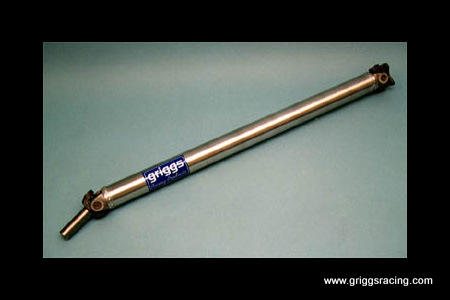
 
The remaining problems are generally the result of a well-meaning installer trying to shim the TorqueArm to create a high-performance pinion angle. There is no such thing! The TorqueArm installation sets the pinion angle, and prevents it from changing under load. If the TorqueArm is installed, as delivered without modification, a car in good condition should not vibrate. However, variations between individual cars may require adjustment to driveline angles–which is a simple procedure.


My street car is supercharged, develops 500 ft./lbs. of torque and traction is terrible. Will the TorqueArm really fix it?
If anybody tells you they can prevent a street tire from spinning on a car with that kind of power, look elsewhere for the truth. It just isn't possible. We can give you the best possible improvement in forward bite that does not compromise the street ability of the car. Mark Ray Motorsport of Charlotte, NC, has a street strip car, which makes 495 ft./lbs. from its Vortech-boosted engine, has run 1.53 60 ft. times on its 8 inch slicks. This kind of time is typical from cars with larger 10 inch slicks! 
Moreover, the car launches and runs perfectly straight and is totally consistent. Our testing with radial street tires show consistent reductions of .2 to .3 seconds over any other rear suspension system.
 
You'll still have some wheel spin, but your car will be predictable and easy to drive.


I have heard all about the GR-40 system. I think I understand it but I have heard you have to do the whole system at once if you want to avoid understeer problems. I can’t afford to spend that kind of money in one chunk. Can the system be done in stages?


Modifications can be done one at a time or in stages. Please call us if you wish to discuss a customized kit. Each additional stage will increase your car’s performance even more than the last, and the total combination gives an unbelievable level of grip and balance. 
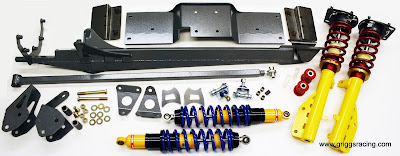
Call for details on our three-stage method. Either way, with a little planning you can get exactly what you want, save money and keep your car fun to drive at every step of the way.

Wednesday, September 28, 2011

The GR40 Suspension System


Why the stock Mustang suspension doesn't work and how Griggs Racing fixes it

In the beginning Fox bodied and SN-95 Mustangs feel so good. There's the easy V-8 power, the light steering and quick handling. Compared to other street cars the Mustang is ready and nimble, a joy to drive.
But for the ever-learning enthusiast there comes a day when that magic Mustang sunshine dims. Often it's because another, modified Mustang showed you its taillights, or perhaps you took your Mustang to the drag strip or slalom. You begin to notice things, like how the rear end seems so inconsistent. At the strip the car never seems to launch the same, and when you get what feels like that rare perfect launch, the tires blow off just as soon as the car gets rolling. Your front tires grind off their outer front edges long before the rest of the tread shows any real wear. Start whipping around freeway ramps faster and your Mustang begins to feel unsure; you find yourself waiting for the rear end to snap out unexpectedly. Ultimately, your Mustang feels more over-powered and less capable than simply fast.


All products are abused on the track prior to making it to the street.


Those first moments of insecurity about your Mustang's white-knuckled handling at the limit, or its fickle appetite for traction at the strip are not your imagination hitting the rev limiter. Those are the first realizations the Mustang chassis is far from delivering the confident handling its high-output powertrain deserves.

At Griggs Racing we've dissected the Mustang chassis and suspension to identify its shortcomings and engineer cures. Our fix for the Fox and SN95 chassis Mustang is no quick medicine; it's a fundamental change in the suspension geometry that yields a fundamental handling improvement. Our suspension is also adaptable to a huge range of Mustang performance. From the street, to the strip, road course or slalom circuit, our re-engineered GR-40 suspension system provides the stable, consistent, responsive platform you need. It's only shortcoming is it has to be experienced to be believed.


So what are the issues working against you in the Fox and SN95 chassis Mustang? For starters, the unibody structure is lightly built, with insufficient rigidity. High torque and cornering loads deform the structure, causing the suspension to lose precision, doubly so with convertibles. Welding in reinforcing structure is the cure.


Knowing where to reinforce the structure is important, as indiscriminately adding braces wastes money and adds weight without gaining meaningful increases in rigidity. By twisting a Mustang unibody on a frame table, we learned the main problem is in the middle of the car. Ford counts heavily on the rocker panels as the primary structure between the firewall and rear wheelhouses, especially with the '79-'04 cars. This lets the front and rear axle forces to twist the car far too easily.


Naturally, a full roll cage will cure this, but that solution is cumbersome and expensive on street cars. More practically, a dual-plane brace to provide triangulation of the floor pan is required; we do this with our Full Frame Kit.

The mid-car twist also explains why we don't offer g-load and strut tower braces. By strengthening one end of the car they actually increase the mid-car twist.

An even larger concern is found in the rear suspension. Ford uses a 4-link design, but with the upper two control arms angled heavily outward. This means the lower and upper rear control arms are not parallel, so as the suspension moves the upper arms are twisted in their bushings. During performance driving this quickly leads to a near total binding of the rear suspension, called roll bind. With the axle bound, it acts like a giant anti-sway bar, causing the rear roll stiffness to skyrocket and the overloaded rear tires to loose traction and spin. This is why the rear end snaps into uncontrollable fishtailing when cornering, and it is also why the rear tires break loose at the drag strip once the body starts rising from the initial power hit.


2005+ Griggs Racing TorqueArm and Panhard Bar


Ford addresses the roll bind by fitting the upper arms with very soft bushings, a sloppy fix, to say the least. Our cure is to fit a torque arm and either a Panhard bar or Watts link to provide the necessary axle location, then remove the stock upper arms. Roll bind is then impossible, and the tires freely follow the pavement.

You may have noticed we use two locating devices, the Torque-Arm, and either a Panhard Bar or Watts link, to do the job Ford uses just the upper control arms for. This is to separate control of the fore-and-aft engine and braking loads from the lateral suspension loads. More precise suspension control is then possible.


GR40 Watts Link
Additionally, the rear roll center is now defined by the Panhard bar or Watts link instead of the upper control arm angle as Ford had it. Stock the Mustang's rear roll center is far too high, which overloads the outside rear tire and causes oversteer. By lowering the rear roll center with the Panhard bar or Watts link we get the rear tires to carry more of the load so the rear end will stick longer.
More compromised geometry is found in the front suspension, a point made abundantly clear when driving a car with the rear suspension fixed and the front suspension stock. Ford built the Mustang with generous steering axis (king pin) inclination, which requires equal amounts of caster to keep the tires flat to the ground when turned. Unfortunately, Ford gave the Mustang only minimal caster, a condition we reverse with caster plates and redesigned K-member.


GR40 SLA System
Also at the front, Ford's tall ride height comes into play. Lowering the entire car benefits the center of gravity, but causes the front suspension geometry to lower the front roll center well below ground level. Combined with the tall rear roll center, this results in a roll couple (the relationship between the front and rear roll stiffness, of which roll centers play a part), to heavily load the front tires. Imagine trying to drive your Mustang around a corner with the front end squashed below ground level and the rear end raised a yard or so in the air; obviously the car would be trying to turn using just its front tires. That's about what the stock suspension tries to do. Lowering the rear roll center with the Panhard bar or Watts link helps this condition, of course, but we also raise the front roll center, accomplished by relocating the points where the front suspension attaches to the chassis. Moving the suspension pickup points is done by redesigning the K-member, which is the crossmember the front suspension attaches to. Redesigning the K-member also allows us to add more anti-dive to the front suspension help correct the lack of caster.

Ackermann is also a concern on stock Mustangs. Ackermann is the steering geometry that steers the inside front tire more than the outside tire, a necessary condition as the inside tire follows a smaller diameter turn radius. With the Mustang, Ford actually ended up providing reverse Ackermann, meaning the front tires toe-in slightly when turned. We also cure this with our K-member.
So, did Ford really goof terribly on the Mustang? Well, not by accident. By selling a relatively high-powered, inexpensive car into the youth market, Ford wanted a car that signed off in the handling department so soon that only the fool-hardy would get in high-speed trouble with it. In short, Ford designed the Mustang for inexpert drivers.

Unfortunately, dumbing-down the chassis is a common manufacturing tactic in the affordable performance car market. That is why it is so difficult to describe the incredible improvement a complete chassis re-engineering provides; few enthusiasts have experienced the huge thrill of piloting a powerful V-8 machine that starts, sticks and stops as well as it's engine goes. Once you've wheeled a GR40 car, however, you'll be one of the few.

Monday, September 26, 2011

The GR40 Mustang Experience


Although the S197 Mustangs are a huge improvement over their predecessors, their limitations remain, designed to keep average drivers cocooned. Understeer is, if not grinding, excessive to the enthusiast. Precision is leagues better but hardly ideal, the rear axle hops when driven hard and the whole thing is too heavy. Furthermore, as power is significantly increased with superchargers and such, the compromises in the stock suspension are made more apparent. So, while the S197 Mustangs do well making the meek feel sporty, they still need significant help before they are sporting.
Griggs Racing GR40
As we investigated the new Mustang, we were thrilled to find a highly rigid—if heavy—chassis, and disappointed to encounter weaknesses in the spindle, ball joint and K-member. They dashed any hope of lightly modifying the car up to Griggs standards, resulting in a new set of highly developed A-arm front suspension parts that are lighter, stronger, more durable and far more precise. In the rear Ford’s 3-link suspension needs corrective measures when lowered, and is best replaced by our proven torque arm system for the ultimate in axle control and traction. The bright spot is the unibody; thanks to Ford’s stiff chassis there is no need for supplemental reinforcements such as subframe connectors, saving money, time and weight.
Transformed with a full Griggs suspension, the result is simply stunning. The GR40 suspended S197 Mustang graduates into a real sports car; a delightful, precise companion in the curves. Building on Ford’s new found chassis rigidity, the Griggs SLA front and torque arm rear GR40 suspension puts feel in the steering and delivers front end grip that has to driven to be believed. The car points into the corner with enthusiasm and carves right down to the apex with a light, precise, linear feel to the steering. This authority is even more appreciated in mid-corner, the place where the stock steering goes vague and responds slowly and unevenly. Here the GR40 front suspension, its tires flatly planted to the asphalt, answers with immediate, precise corrections. It’s a revelation to anyone experiencing the joy of piloting a precise, spirited chassis for the first time, or to the old hand who didn’t expect such excellence from a heavy powerhouse such as the Mustang.

Squeeze on the power and the GR40 answers with torque-arm traction, the bite that handles both huge torque and yet remains precise to the throttle. And bumps? They soak into the rear suspension and stay there while the tires remain on the ground. This is one confidence inspiring suspension; you can stand on the gas and the rear tires will claw the car forward while the supple front end takes care of directional duties without fuss.

Griggs Racing S197
Also unexpected is the incredibly civil ride from the GR40 suspension. It feels as plush as the stock suspension, and in the bumps when trying hard, even more so. The combination of stiff chassis and accurate, correct GR40 suspension geometry means we can let the wheels move up and down, which in turn delivers a ride that’ll please the fussiest daily commuter.
If the GR40 system has a fault on the S197 it’s that it works so well you’ll want more from the tires. The car tracks so honestly right up to the limit, and has such gentle manners as the tires sign off that you’ll be ready for more grip. It’s that good.
Griggs Racing 4 on 4 Brakes
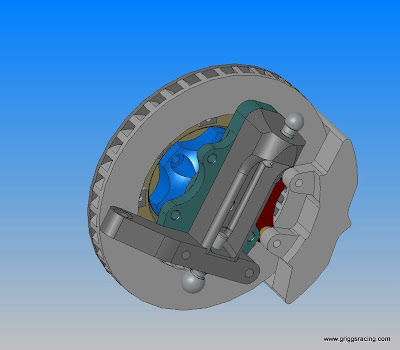
I must also mention the 4on4 brakes. Besides reducing unsprung weight, these brakes offer a new level of precision in the brake pedal. This is especially true in the brake release, an area where stock brakes are absolute dullards. The 4on4 brakes let go of the discs with the same sensitivity they apply them; on open track day that means slowly coming off the brake in perfect confidence while the tail end –so expertly controlled by the GR40 gear—rotates magnificently outward as much or as little as you wish. The transition from threshold braking to the throttle while holding the car at the limit has never been so rewarding.

So yes, the S197 Mustang is a huge step forward by Ford, and the GR40 suspension delivers the full promise of this greatest of all Mustangs